
What Does a Cyclone Making Landfall Mean? What Happens During This Critical Stage?
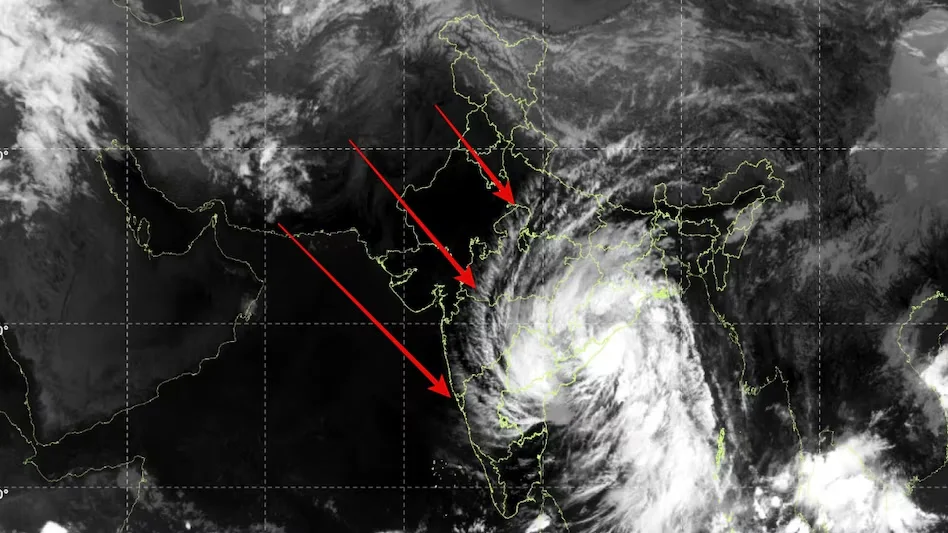
Understand what cyclone landfall means, why winds intensify, how storm surges form and why cyclones can remain dangerous after moving inland.
What Exactly Is Landfall?
The term “landfall” is often used when a cyclone approaches a coastal region. It refers to the point at which the centre of a tropical cyclone crosses the coastline from the sea onto land. A cyclone moving close to the coast or travelling parallel to it does not necessarily mean that landfall has occurred. Meteorological agencies identify landfall by tracking the storm’s centre and movement.
Is There a Calm Area at the Centre of a Cyclone?
A well-developed cyclone may have a central region known as the “eye.” Winds there can be relatively light, and conditions may temporarily appear calm. However, the eye is surrounded by the eyewall, where some of the strongest winds and heaviest rainfall occur. A brief lull in wind does not mean the danger has passed. As the storm moves forward, powerful winds may return from a different direction.
Grow Your Business with Janatha Mirror
Reach 50,000+ daily readers across Andhra & Telangana
Why Can the Sea Rise During Landfall?
Strong cyclone winds can push seawater towards the coast, causing the water level to rise above its normal level. This phenomenon is called a “storm surge.” It is different from ordinary waves and can lead to severe coastal flooding. The extent of a surge depends on several factors, including the cyclone’s intensity, wind speed, coastal shape, underwater slope and the timing of normal tides. Low-lying coastal areas are particularly vulnerable.
Why Does a Cyclone Usually Weaken Over Land?
Grow Your Business with Janatha Mirror
Reach 50,000+ daily readers across Andhra & Telangana
Over warm ocean water, a cyclone receives moisture and energy that help sustain its circulation. Once it moves inland, its supply of moisture from the sea is reduced. Friction from land surfaces, buildings, trees and terrain also disrupts the storm’s circulation. As a result, a cyclone generally weakens after landfall. However, heavy rainfall, flooding, fallen trees and power disruptions can continue even as wind speeds decrease.
How Long Does Landfall Take?
The landfall process can last several hours, depending on the storm’s size, forward speed and intensity. Even after the centre crosses the coastline, strong winds and rainbands can continue affecting nearby districts and areas farther inland. That is why weather warnings remain important before, during and after landfall.
What Should People Do During a Cyclone?
People in vulnerable coastal areas should follow official weather alerts and evacuation instructions. They should avoid beaches, exposed shorelines and flood-prone locations during dangerous conditions. Stay away from fallen power lines, damaged buildings and uprooted trees. Even if the winds temporarily become calm, remain in a safe place until local authorities confirm that the danger has passed.
Grow Your Business with Janatha Mirror
Reach 50,000+ daily readers across Andhra & Telangana
The key takeaway: Landfall is a major stage in a cyclone’s journey, but it does not mean the threat ends immediately. Timely warnings, evacuation when advised and basic safety precautions can help protect lives.
💬 Reader Opinions & Discussion0
Login Required to Share Your Opinion
Only verified and logged-in readers can post opinions on Janatha Mirror news stories.